
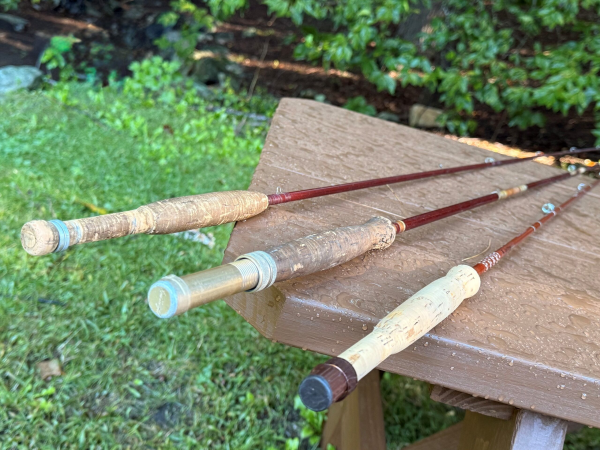
With all the high-tech, high-priced modern fly rods out there, no fly fisher is immune from the allure of the upgrade. However, the small stream fly fisher might just be the most resistant to the contagion. An old fly rod will do just fine on a small stream.
After all, in that description the “fly rod” is much more essential to the angling equation than the “old.” A fly rod is what is needed to get the job done. The manufacturer, to a certain degree the design, and the length of time the tackle has been in a closet are much less important. As is often quipped: the fish don’t care.
There are two primary reasons why we use and love old fly rods on small streams: They are practical and they are beautiful. (I’ll explain what I mean by beautiful later in the post.) But it is sufficient to say that these categories are each reason enough to fish your old fly rod. It must also be said that they are certainly not mutually exclusive.
The Practical
Many people fish with an old fly rod because they have it. It was your grandpa’s or your dad’s. You picked it up at a yard sale. Instead of buying something, it gets fished because it is there. Much could be said about the utilitarian and inconspicuous aspects of the practicality of fishing with whatever you already have. But just because you own something doesn’t mean its practicality extends to being an ideal angling tool.
This is where the next facet kicks in: many old fly rods were designed with a little more “oomph.” Bamboo, glass, and early graphite was a little heavier – even in shorter lengths. Especially towards the handle and in the butt section, these rods were a little more sturdy. Finesse presentations of tiny dries still works because of the delicate and flexible tips. And practically, this combination makes for the ideal small stream fly rod.
You can throw any fly. You can maneuver well through underbrush. And you can slow down a little when casting little fluffy dries. It possesses the features that are packed into $500 fly rods today. But you already have it, so there you go.
The Beautiful
Once more, many people fish with an old fly rod because they have it. Even if it wasn’t passed down in some sentimental manner, even if its previous owner didn’t fish with it very much – it provides some sort of connection. You’re connected with him and you’re connected to generations of anglers who came before you. The aesthetics are the authentic version of what so many companies “throw back” to in their nostalgic marketing.
In the hand, the rod probably feels good as well. We can all be honest enough to acknowledge that it isn’t going to be as light, responsive, or efficient as what has been produced in the last 30 years. Yet on the small stream this doesn’t matter as much. Your 15 foot casts are dialed in with the rod. In a pinch, you can haul out a longer presentation and really feel the rod load. It is a pleasure to fish.
If you have an older (pre-1961) fly rod, you might notice that there is no line weight number listed on the blank. There was an alphabetical convention that corresponded to silk line diameters. If you’re curious about the line rating for that old rod, here is a conversion chart for some of the small stream weight comparisons:
- 3-weight: IFI (DT) – IFG (WF)
- 4-weight: HFH (DT) – HFG (WF)
- 5-weight: HEH (DT) – HEG (WF)
Of course, the best thing to do is cast multiple lines to find which one suits the rod and your stroke – regardless of what it was rated for.
Always keeping my eyes open for cool old rods. Over the years I have really grown to appreciate slower rods and I think the technology of older generations lends itself to that kind of rod.
It is amazing what one can find if they just look for fishing rods leaning against tables as you drive by yard sales!